
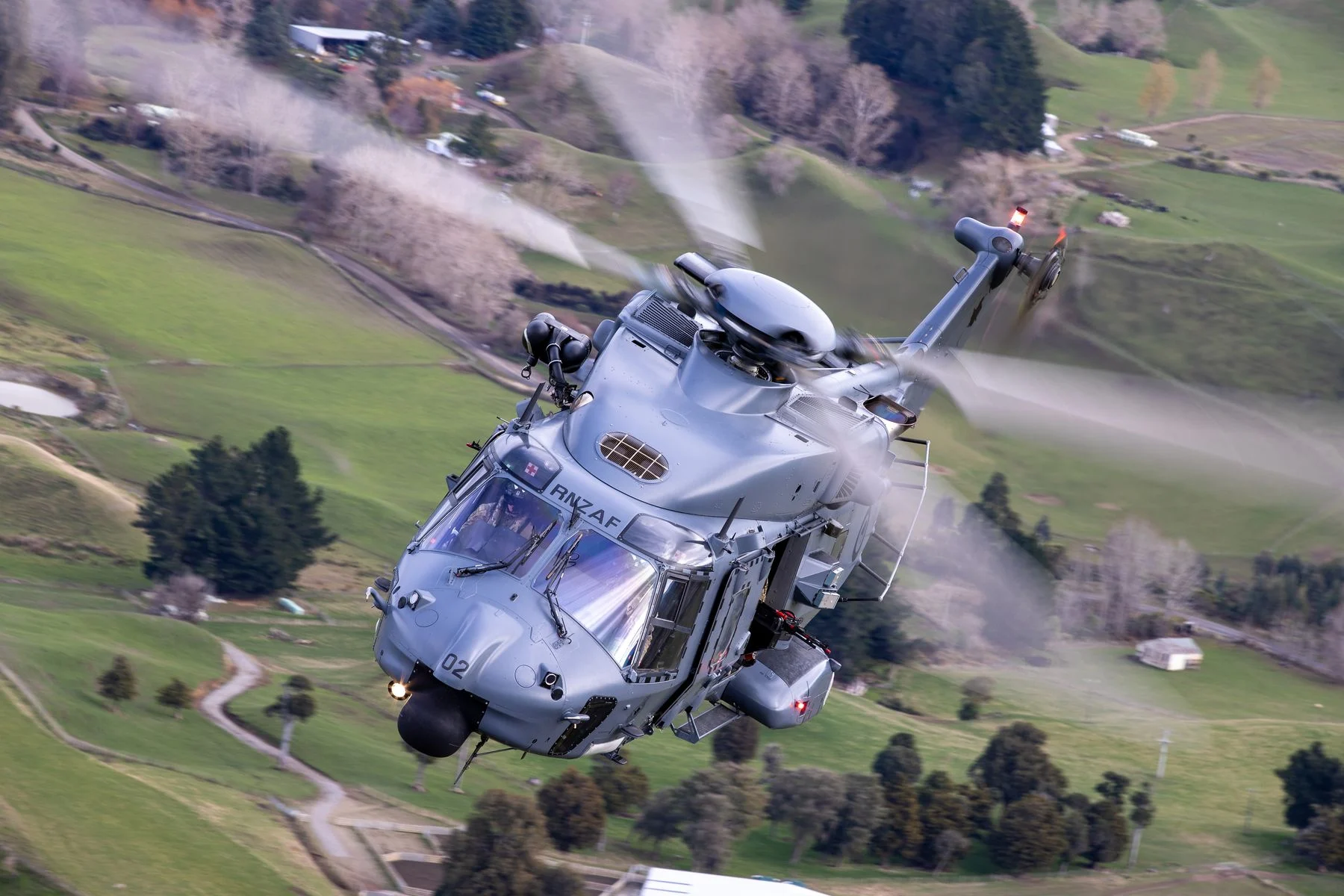
A Royal New Zealand Air Force NH90, flown from a fleet of just eight aircraft, has become the first of its type anywhere to reach 3,000 flight hours, a milestone Airbus attributes to operational intensity rather than fleet size.
A SMALL FLEET SETS A GLOBAL BENCHMARK
On Wednesday 26 August 2026, an NH90 Tactical Troop Helicopter designated TNZA002, based at RNZAF Base Ohakea, became the first NH90 anywhere in the world to pass 3,000 flight hours. Of roughly 530 NH90s in active service worldwide across multiple configurations, New Zealand’s No. 3 Squadron leads the entire international fleet, a benchmark it reaches from a base of just eight operational aircraft. The record reflects operational intensity rather than aircraft age, since older NH90 airframes continue flying across Europe; New Zealand’s first two NH90s arrived in December 2011 to replace the Air Force’s ageing Iroquois fleet, and fifteen years on, the RNZAF flies each aircraft harder and more frequently than any other operator.
“It’s a significant achievement for what is a small fleet and small team,” NH90 Flight Commander Squadron Leader Lachie Johnston said. “We need to always have these aircraft available to fly and it’s a testament to the maintainers, who put in the long days in often trying conditions to get the helicopters flying, as well as the supply chain, and the fleet planners. They are the secret sauce to our success.”
BUILT FOR THE FRONTLINE
New Zealand’s NH90 fleet supports a wide range of civil and military missions: tactical troop transport, search and rescue, casualty evacuation, support for police and government agencies, alpine operations, maritime deployments from HMNZS Canterbury, and humanitarian disaster relief across the Pacific. That rate of effort has been demonstrated repeatedly during the country’s most severe natural disasters. When the November 2016 Kaikōura earthquake severed every road into the region, RNZAF NH90s had established an emergency air bridge by midday. Patrick Power, Airbus’s team lead for the NH90 programme and the only person in New Zealand to have worked continuously on the platform since its introduction in 2011, across both uniformed RNZAF and civil Airbus roles, was in the middle of the response, arriving in Christchurch that evening with three NH90s to deliver aid and evacuate stranded civilians.
“Trucks would arrive with aid and we would load it onto the helicopter, they would depart for Kaikōura, and return with a full load of people,” Power recalls. “We would load it again, repeating that cycle many times a day.” Maintainers had to keep pace on the ground. “I always remember we had to clean the windscreen every time they came back because there were so many other helicopters in the sky doing rescue work that any small black mark looked like another aircraft,” Power says. “The rate of effort was intense as we had to perform all the maintenance and get them ready for the next day, but it was very rewarding because you knew you were making a difference.”
A similar pattern unfolded during Cyclone Gabrielle in February 2023. When the commanding officer of No. 3 Squadron asked the maintenance team how many aircraft could be readied, a surveying NH90 had just radioed back requesting maximum assistance as floodwaters rose rapidly around trapped residents. Power, then serving as hangar manager in charge of day-to-day maintenance, had seven of the fleet’s eight helicopters made available that day; with the eighth mid-servicing, that was every available aircraft deployed into the response. Over the course of the disaster, No. 3 Squadron crews evacuated 384 people and 23 pets, many winched directly from the roofs of submerged homes, while transporting 25,600 kilograms of external cargo and 66,810 kilograms of internal cargo. The fleet was also deployed for the 2019 Whakaari/White Island eruption and the 2020 Australian bushfires.
AN EMBEDDED MAINTENANCE PARTNERSHIP
Sustaining that rate of effort rests on a maintenance arrangement Airbus Helicopters has run inside the RNZAF’s own organisation at Ohakea since 2015. Working alongside Air Force mechanics such as Aviator Warren Bignoux, who carries out system checks and overhauls on his way to becoming a licensed engineer, the joint Deeper Maintenance team performs the major 600-flight-hour servicings that take around three months per airframe. Power, who trained on the type in Marignane in early 2011 and helped establish the initial deeper maintenance line in 2015 alongside Airbus specialists from Brisbane before transferring to Airbus himself in 2017, has seen the embedded workforce grow from four to ten people over that time, providing the kind of continuity that feeds directly into training, repair development, procedure updates and technical risk assessments.
Airbus says RNZAF NH90 fleet serviceability runs at around 75 percent, which the company describes as far surpassing the global operator average, a comparison WAN has not independently verified. The Ohakea team also completed a major fleet-wide software upgrade, Software Release 2, in what Airbus describes as record time, making New Zealand the first country to complete the upgrade across its entire fleet.
Power says that after fifteen years on the type, he still finds something new to learn most days, and that the challenge of continuous improvement is what keeps the role engaging. Alexandra “Allie” Thompson, an Airbus avionics technician who has spent two and a half years on the embedded team focusing on 600-plus-hour checks, said of the type: “Because they’re an older aircraft and not brand new, there’s always going to be something fun to fix.” She describes the role as a distinctive one for a civilian to hold on a military aircraft, and points to the wider opportunities that come with working for an international company such as Airbus.
Source and Images: Airbus