
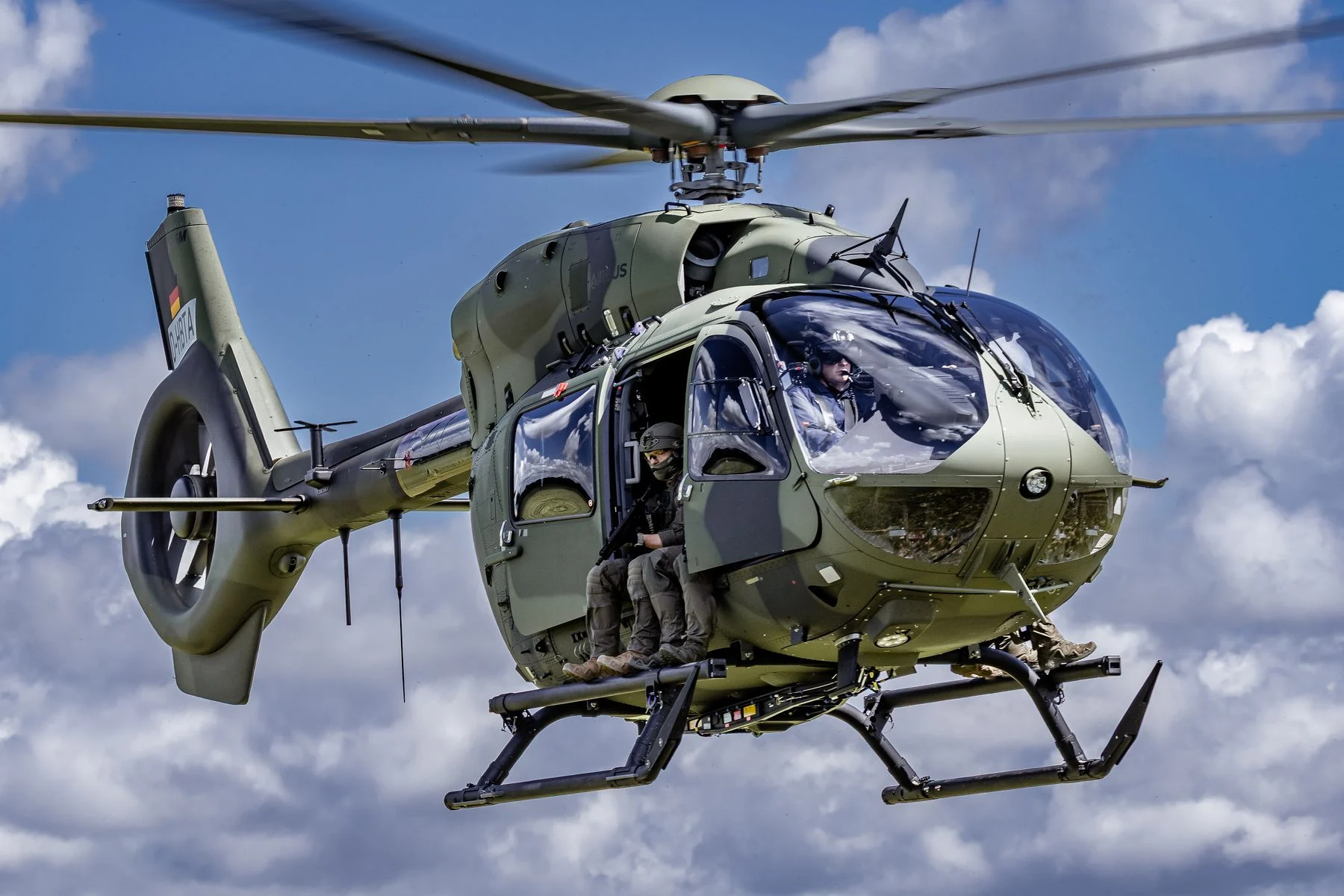
The European Next Generation Rotorcraft programme, backed by 12 EU member states and a 53-member consortium, aims to fly a NATO-oriented helicopter design by the end of the next decade.
What will a helicopter need to be decisive on the battlefield, next decade and beyond? European stakeholders are already working together to design the military helicopter of the future, and Airbus is playing a key role through the European Next Generation Rotorcraft programme, known as ENGRT.
“There has been an international NATO-led initiative to scope a future helicopter that will encompass the most advanced technology that is both currently available and will soon become available,” said Ralf Weber, Campaign Manager at Airbus Helicopters. “This project is Europe’s response. It should be flying by the end of the next decade.”
A DESIGN FOR EUROPEAN SECURITY
The scale of ENGRT is reflected in its backing: the programme is supported by 12 EU member states, including Austria, Belgium, Denmark, Finland, France, Germany, Greece, Italy, Latvia, the Netherlands, Poland and Spain, and aims to mature critical technologies required to protect Europe in highly contested environments. Airbus Helicopters, with Leonardo, co-leads and coordinates a 53-member consortium of industrial and institutional partners.
According to Weber, European militaries see operational durability, easy maintenance and survivability as the main requirements, with the ability to operate in areas exposed to enemy weaponry a particular priority given current conflicts. “This is what we see in Ukraine,” said Weber. “When discussing with our home nations partners, where we see interest is in increasing the survivability of the crew and the machine. So we have to find the sweet spot: a machine that is highly sophisticated in terms of its systems, its mission system, its avionics, sensors and even self protection, reducing pilot workload and allowing them to focus on the mission. Then it has to be really manoeuvrable for tactical flight, for example, flying a single-pilot tactical flight thirty feet above the ground at 130 knots at night. That’s something that is really challenging, and it will also be an important part of the future role of this helicopter.”
Weber said maintenance is another key driver: “It also has to be robust and resilient from a Support and Services point of view. Ready for conflict. Our objective is to reduce the maintenance burden for this next-generation machine by 50% compared to existing machines, and really maintain it with standard tools and as small a logistical footprint as possible.”
AVIONICS, CONNECTIVITY AND CREWED-UNCREWED TEAMING
Weber said the project is crucial because combat is becoming more connected and multi-domain. “Today, our helicopters are one vector of a mission, and we want them to become one part of a whole combat system that can be used in a multitude of ways. So this will bring the systems that are aboard, and the connectivity, to another dimension.” He said the programme must also resolve how a highly connected, specialised machine fits alongside drone teaming: “We are talking about drones, but not only connectivity between one helicopter and one drone, but moving towards a multitude of drones, so controlling many drones while still being fully connected to the battlefield.”
On whether crewed helicopters still have a role to play on future battlefields, Weber was unequivocal: “We have seen over recent years a big discussion about whether the crewed helicopter platform still has a role to play on battlefields fifteen or twenty years from now. And the answer is yes. We’ve seen it in current conflicts. The answer is definitely yes. As long as you transport troops, piloted aircraft are always preferable and a human in the loop on-site will always play an important role in our way of thinking about conflicts. That’s why crewed helicopters will continue to play a role.”
EUROPEAN COOPERATION DRIVING THE FUTURE
Weber said the cooperation among EU member states on ENGRT continues to strengthen Europe’s defence and security infrastructure as a European pillar inside the NATO alliance. The programme is split into phases: the first finished at the end of 2025, and Airbus is now leading the second phase, which began in early 2026, runs for three years, and is co-funded by the European Union, marking a transition from a research and technology project into a research and development one. Weber said work so far has established a baseline technology readiness level for elements such as open system architecture and drone teaming, with the second phase aimed at raising those readiness levels and, by the end of ENGRT II, producing an open-architecture test bench in which the consortium can experiment and build toward future development.
Note: ENGRT stands for European Next Generation Rotorcraft, Europe’s response to a NATO request to design a new military helicopter for future needs, with Airbus Helicopters co-leading the design work and the associated technology requirements. The programme is expected to fly its first rotorcraft before the end of the next decade.
Source and Images: Airbus Helicopters