
Archer Aviation’s second quarter results show revenue of US$5.0 million, a net loss of US$263.2 million and cash and short-term investments of US$1.56 billion, alongside the announcement that it will acquire three Boeing subsidiaries. The scale gap between the reporting company and the business it is buying is the defining feature of the quarter.
THE NUMBERS BEHIND THE ANNOUNCEMENT
Archer Aviation Inc. (NYSE: ACHR) has reported operating and financial results for the second quarter ended 30 June 2026, alongside the announcement that it has signed definitive agreements to acquire Boeing’s Wisk Aero, Insitu and SkyGrid subsidiaries. Revenue for the quarter was US$5.0 million, up from US$1.6 million in the first quarter and from nil in the second quarter of 2025, generated through expanded operations at the fixed base operator business at Hawthorne Airport in Los Angeles.
Total operating expenses were US$284.2 million against US$256.2 million in the first quarter, comprising research and development of US$186.0 million, general and administrative expenses of US$93.9 million and cost of revenue of US$4.3 million. The net loss was US$263.2 million, widening from US$217.7 million in the first quarter and US$206.0 million a year earlier. Adjusted EBITDA was a loss of US$177.1 million, which the company notes is at the lower end of its guidance range of US$170 million to US$200 million. Loss per share was US$0.34.
Founder and Chief Executive Adam Goldstein described the day as an important inflection point for Archer, saying that with the planned acquisitions of Wisk, Insitu and SkyGrid from Boeing, coupled with the recent unveiling of Halo, ZEE and ACES, the company was rapidly advancing a diversified, multi-platform strategy across air taxis, uncrewed aircraft systems and artificial intelligence.
WHERE THE MONEY WENT
Archer ended the quarter with US$1,560.6 million in cash, cash equivalents and short-term investments, plus US$7.3 million of restricted cash — a decrease of US$215.3 million from the first quarter position of US$1,775.9 million. The company attributes the movement to US$156.4 million used in operating activities, US$37.1 million on property and equipment, and US$25.0 million on the acquisition of the fixed base operator business at Hawthorne. Across the first six months, net cash used in operating activities was US$305.5 million against US$198.0 million in the same period of 2025.
One line in the reconciliation is worth isolating. Stock-based compensation expense was US$85.6 million in the quarter — approximately 30 per cent of total operating expenses, and the single largest adjustment between the GAAP and non-GAAP figures. Archer’s non-GAAP total operating expenses of US$192.2 million are arrived at principally by excluding it, together with US$6.0 million of accrued litigation settlement expense and US$0.4 million of acquisition-related costs. Accumulated deficit stood at US$2,784.7 million at 30 June, and goodwill rose from US$0.1 million at the end of 2025 to US$80.5 million, reflecting the Hawthorne acquisition.
A REVENUE BASE ABOUT TO CHANGE SHAPE
The most consequential figure in the release is not in the financial statements. Archer states that Insitu alone will add over US$200 million in annual revenue, based on Insitu’s current financials and financial estimates, with operations across 35 countries. Against Archer’s own quarterly revenue of US$5.0 million, that is a business generating roughly ten times Archer’s current annualised turnover — and Archer describes it as profitable. The transaction, if completed, would convert a pre-revenue certification-stage company into one with an established defence revenue stream, which is the strategic point Goldstein is making about diversification and scale.
Archer has provided guidance of an adjusted EBITDA loss of US$170 million to US$200 million for the third quarter of 2026. The company states it has not reconciled that estimate to a GAAP measure because stock-based compensation expense and changes in the fair value of warrants depend on the future market value of its common stock and are not reasonably predictable.
Note: Third quarter guidance and the projected revenue contribution from Insitu are Archer’s own stated estimates, subject to the forward-looking statements and risk factors set out in its results release and its filings with the Securities and Exchange Commission. The transaction remains subject to closing conditions. Further detail on the transaction itself appears in the accompanying article.
THE REST OF THE QUARTER
Three developments outside the financial statements shaped the period. In July, Archer and Anduril unveiled their jointly developed autonomous hybrid VTOL platform at the Farnborough International Airshow, introduced as Thunder for defence missions and Halo for commercial applications; the two variants share an airframe, hybrid powertrain and core systems with configurable payload. Archer announced ZEE, its aviation-specific AI foundation model built on ADS-B, air traffic control communication, maps and charts, aircraft state, terrain and weather data, and reports a technical breakthrough demonstrating the ability to predict aircraft trajectories on the airport surface minutes ahead.
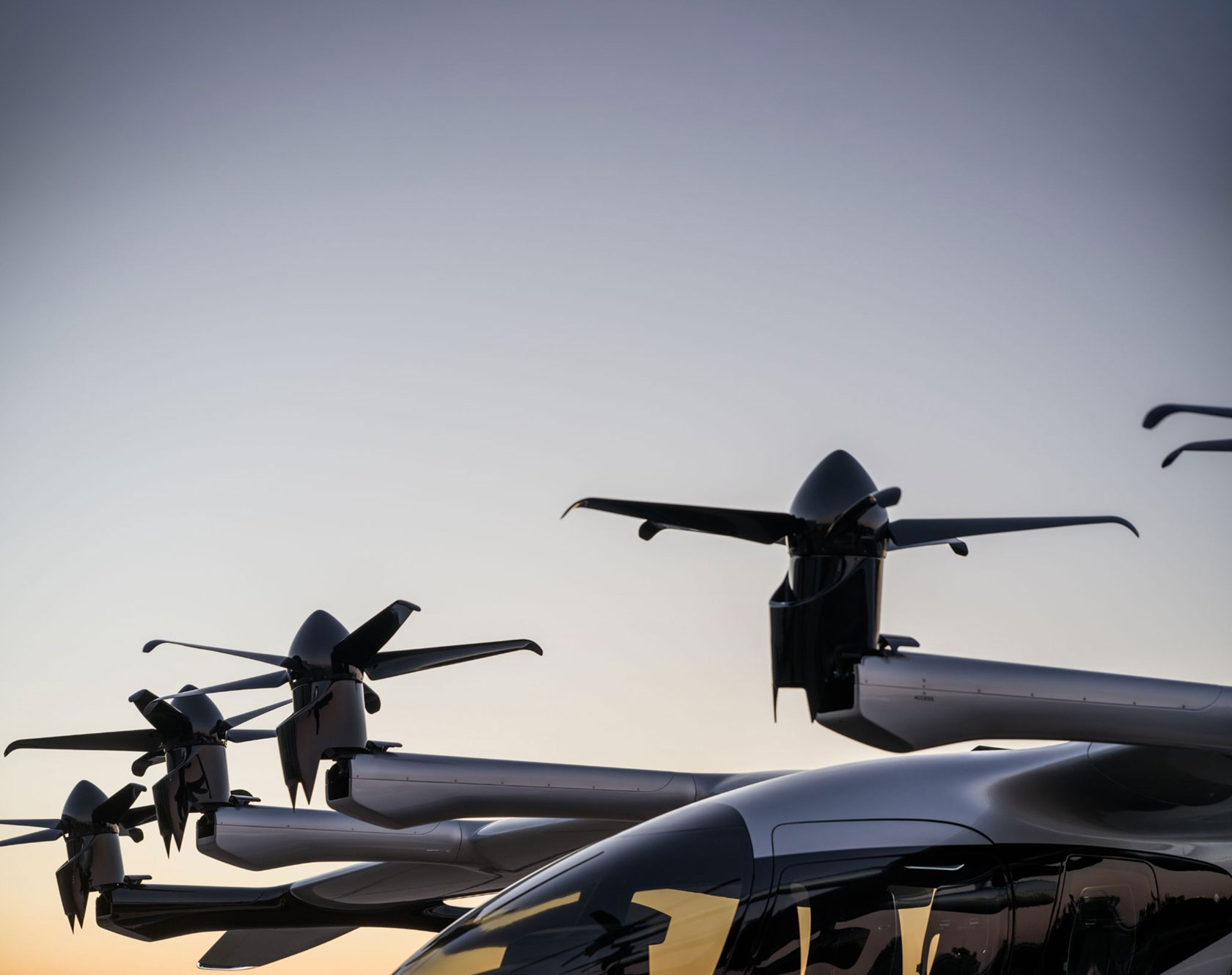
Also in July, a piloted Midnight aircraft completed a round trip between Salinas Municipal Airport and Monterey Regional Airport, each leg taking approximately nine minutes against over 35 minutes by road. The flight was conducted in close coordination with the FAA ahead of planned Midnight operations later this year under the eVTOL Integration Pilot Program.
Source and Images: Archer Aviation Inc.