
China has completed full ground testing of a megawatt-class liquid hydrogen aviation engine, marking a technical milestone in the development of hydrogen-powered propulsion systems.
ENGINE DEVELOPMENT AND TESTING
AEP100 turboprop reaches full-performance conditions
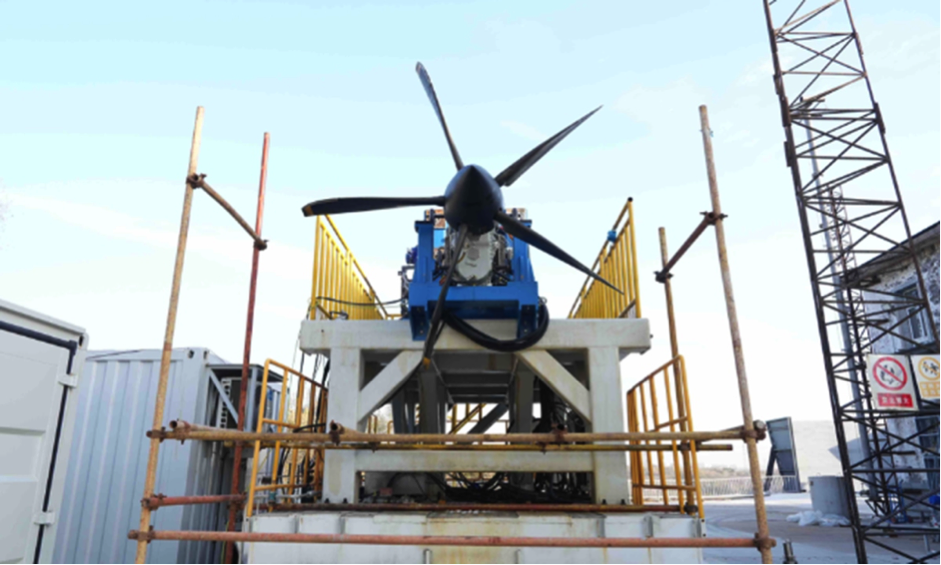
The AEP100 turboprop, developed by a research institute under Aero Engine Corporation of China (AECC), has completed full ground tests, including ignition and performance adjustment under controlled conditions.
The engine was developed by the AECC Hunan Aviation Powerplant Research Institute in Zhuzhou. According to the report, the engine operated stably across all test conditions, with both engine performance parameters and the associated liquid hydrogen delivery system functioning as expected.
TECHNICAL SIGNIFICANCE
Liquid hydrogen propulsion feasibility
The test programme represents China’s first liquid hydrogen aviation engine to meet megawatt-level full-performance standards under ground test conditions.
Liquid hydrogen is identified as a potential aviation fuel due to its high energy density and zero carbon emissions at the point of use. The successful testing is reported to demonstrate the technical feasibility of liquid hydrogen turbine power and supports progression towards engineering-level applications.
POTENTIAL APPLICATION PATHWAYS
Initial use cases in specialised aviation segments
According to the report, initial applications for liquid hydrogen propulsion are expected in unmanned aerial logistics and regional aviation, with possible longer-term extension to larger aircraft categories.
The development is also positioned within a broader industrial context, including hydrogen production, liquefaction, storage, transport and refuelling infrastructure.
TECHNOLOGY READINESS AND LIMITATIONS
Early-stage development with operational constraints
Industry commentary cited in the report indicates that liquid hydrogen aviation engines remain in an exploratory phase globally. Current limitations include equipment lifespan, storage complexity, cost, safety considerations and overall system performance.
It was noted that the technology is unlikely to be deployed in commercial passenger aviation in the near term, with nearer-term applications expected in research or specialised operational environments.
DECARBONISATION CONTEXT
Balancing emissions reduction with operational requirements
While hydrogen propulsion offers potential emissions reductions, the report highlights that any transition from conventional aviation fuels will require new systems to meet established benchmarks for cost, performance, safety and reliability.
SOURCE AND IMAGEL AECC Hunan Aviation Powerplant Research Institute