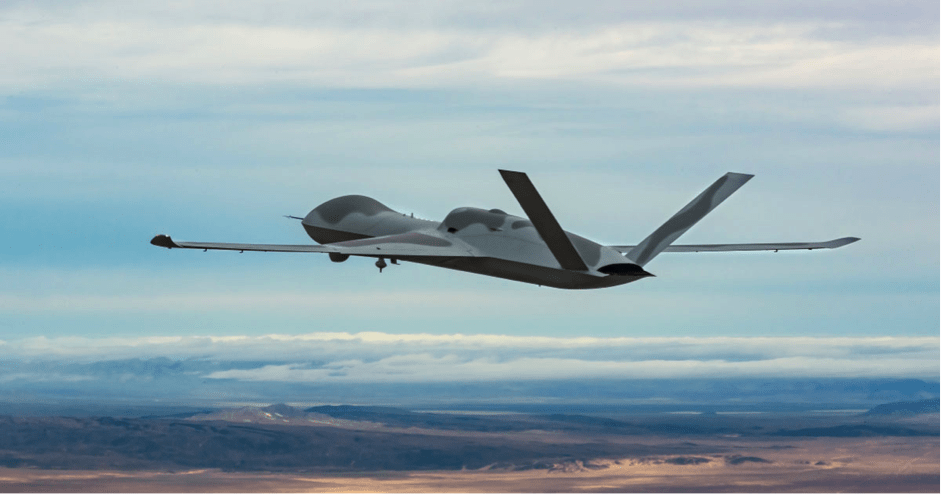
General Atomics Aeronautical Systems (GA-ASI) has completed another milestone in autonomous air combat development, successfully conducting a company-funded demonstration flight featuring a fully autonomous aerial intercept using its MQ-20 Avenger.
The demonstration, conducted on 18 January 2026 from San Diego, employed the MQ-20 Avenger equipped with the latest government reference mission autonomy software. The flight included a live engagement against an aggressor aircraft flown by an onboard human pilot, underscoring the maturity of GA-ASI’s autonomous systems and their ability to integrate sensing, decision-making and execution without human intervention.
Autonomous Mission Execution
The mission began with planning through a Human-Machine Interface (HMI), after which the autonomy profile was uploaded to the aircraft. Once airborne, engineers confirmed a successful and seamless transition between mission autonomy and flight autonomy systems, demonstrating the platform’s ability to dynamically adapt to mission requirements.
Throughout the sortie, the MQ-20 adhered strictly to operator-defined Keep-Out Zones (KOZ) and Keep-In Zones (KIZ), remaining within authorised airspace and avoiding restricted areas during all phases of flight.
A key highlight of the demonstration was the use of a live Infrared Search and Track (IRST) sensor supplied by Anduril. Using passive sensing alone, the MQ-20 independently detected and ranged the target aircraft, established a track, calculated an intercept solution and simulated a weapon engagement. According to GA-ASI, the simulated shot, had it been live, would have resulted in the destruction of the target.
Complex Mission Elements
Beyond the intercept scenario, the autonomous system demonstrated a range of operational behaviours typically associated with human pilots. These included flying a pre-designated route to a standard instrument hold, maintaining the hold pattern, and then proceeding to subsequent waypoints. The aircraft also executed routes commanded via Heading, Speed and Altitude (HSA) inputs, all while continuing to respect designated airspace constraints.
GA-ASI noted that the Avenger has served as a surrogate platform for Collaborative Combat Aircraft (CCA) concepts for more than five years, both prior to and following the introduction of its purpose-built XQ-67A and YFQ-42A designs.
Broader Autonomy Development Efforts
The latest demonstration forms part of GA-ASI’s wider investment in autonomy, human-machine teaming and rapid capability maturation for military operators. In recent years, the company has pursued multiple collaborations to expand its technological base, including additive manufacturing initiatives with Divergent Technologies, and operational integrations with US Air Force Special Operations Command.
In 2025, GA-ASI partnered with Shield AI to conduct two Avenger flight demonstrations using the Hivemind mission autonomy software, further advancing autonomous mission execution capabilities.
A Mature Autonomy Platform
With more than nine million flight hours logged across its unmanned aircraft portfolio, GA-ASI continues to position the MQ-20 Avenger as a critical testbed for next-generation autonomous air combat systems. The latest autonomous intercept demonstration highlights the growing sophistication of onboard sensing, reasoning and execution, and signals continued momentum in the development of operationally relevant autonomy for future combat aviation.
SOURCE AND IMAGE: General Atomics Aeronautical Systems (GA-ASI)