
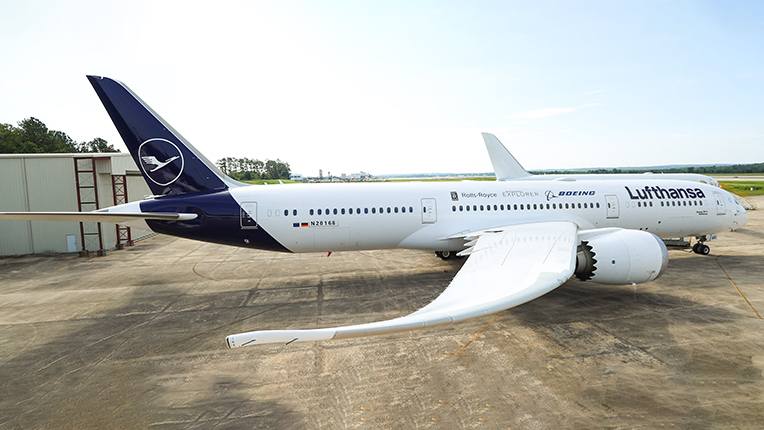
Rolls-Royce, Boeing and Lufthansa have commenced flight testing of two fuel efficiency and noise reduction technologies on Boeing’s 2026 ecoDemonstrator Explorer — a Boeing 787-9 fitted with Rolls-Royce Trent 1000 engines — as part of Phase III of the FAA’s CLEEN programme, with testing running from Glasgow, Montana, through mid-August 2026.
NEXT GENERATION INLET AND AI-GENERATED FLIGHT PATHS HEAD TO FLIGHT TEST
Rolls-Royce, Boeing and Lufthansa have begun flight tests of two technologies with the potential to reduce fuel consumption and community noise on commercial aircraft, conducted on Boeing’s 2026 ecoDemonstrator Explorer — a Boeing 787-9 Dreamliner powered by Rolls-Royce Trent 1000 engines that is scheduled to be delivered to Lufthansa following the completion of the test programme. Testing commenced at the Boeing site in Glasgow, Montana, and is expected to run through mid-August 2026, with the programme forming part of Phase III of the FAA’s CLEEN (Continuous Lower Energy, Emissions and Noise) programme.
The two technologies under evaluation are distinct in nature and address different parts of the fuel efficiency and noise reduction challenge. The first is the Next Generation Inlet — a reduced-length engine inlet demonstrator incorporating advanced acoustic treatments — which enables the integration of more fuel-efficient, larger-diameter engines onto future aircraft platforms while simultaneously reducing weight and aerodynamic drag and maintaining or improving acoustic performance. The second is a set of algorithmically generated departure and arrival procedures, termed Intelligent Operations flight paths, which use multiple data sources to identify opportunities to reduce noise for communities around airports while also improving fuel efficiency on the climb and descent profiles where aircraft are closest to population centres.
THREE PERSPECTIVES ON A DECADE OF PARTNERSHIP
Boeing Chief Technology Officer Lane Ballard described the ecoDemonstrator Explorer as one of many promising concepts Boeing was working on, saying the more efficient inlet and Intelligent Operations flight paths had the potential to make aircraft even more valuable to partners including customers like Lufthansa and suppliers like Rolls-Royce. Grazia Vittadini, Chief Technology Officer of Lufthansa Group, said the airline was pleased to support the 2026 ecoDemonstrator Explorer programme alongside Rolls-Royce and that together they aimed to help advance aviation’s transformation by testing technologies with the potential to improve fuel efficiency, reduce noise and prove their value in real-world conditions.
Alan Newby, Director of Research and Technology at Rolls-Royce, described the programme as the culmination of a decade of collaboration with Boeing, built on a shared ambition to reduce noise, improve efficiency and unlock more sustainable flight. He said Rolls-Royce was building on extensive prior research to test technologies in real-world conditions and see how they performed where it mattered most — in service. The FAA’s CLEEN programme, through which the testing is conducted, is a public-private partnership designed to accelerate the testing and development of technologies that enable manufacturers to build aircraft and engines with improved fuel efficiency and reduced noise. Julie Marks, Executive Director of the FAA’s Office of Environment and Energy, said the tests demonstrated how the CLEEN programme’s public-private model supported the development and integration of advanced technologies into current and future aircraft.
ECODEMONSTRATOR PROGRAMME CONTEXT AND TRENT 1000 BACKGROUND
Since 2012, Boeing’s ecoDemonstrator programme has accelerated technology maturation by moving innovations out of the laboratory and into an operational test environment, having evaluated more than 260 technologies to date across safety, fuel efficiency, emissions, noise and operational efficiency. The Trent 1000 engine powering the 2026 ecoDemonstrator Explorer has been in service since 2011 and has been continuously improved by Rolls-Royce across successive variants. The current production standard, the Trent 1000 XE, powers all new 787 Dreamliner deliveries and is being used to upgrade Trent 1000 TEN operators to the latest standard, improving their operating experience. The Next Generation Inlet testing builds on an extensive prior Rolls-Royce research programme into fan aerodynamic performance, exploiting the architecture and technologies of successive Trent engine generations.
Source and Images: Rolls-Royce / Boeing / Lufthansa Group