
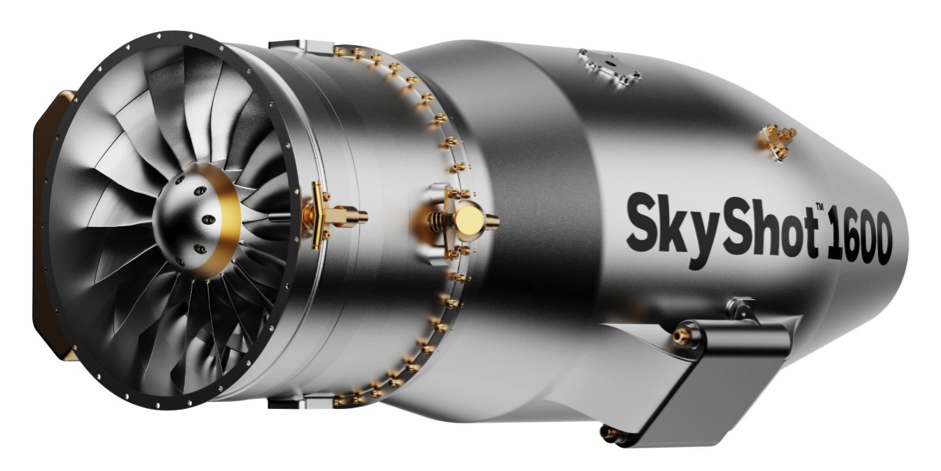
The U.S. Air Force has awarded Honeywell a prototype contract to develop a lightweight engine based on the SkyShot 1600 for its Collaborative Combat Aircraft programme.
By Douglas Royce
Prototype contract awarded under Propulsion Consortium Initiative 2.0
The U.S. Air Force has awarded a prototype contract to Honeywell for the design of a lightweight engine intended for autonomous aircraft. The design will evolve from the company’s small-thrust-class SkyShot 1600 engine.
The award supports the Air Force’s Collaborative Combat Aircraft (CCA) programme, which is focused on developing a large fleet of autonomous, relatively low-cost aircraft. These “loyal wingman” platforms are designed to operate alongside manned fighters such as the F-22 and F-35, serving as extended sensors, flying weapons bays or tactical decoys.
Should Honeywell secure a long-term position within the programme, the requirement could extend to the production of hundreds or potentially thousands of small engines in the years ahead.
Contract structure and programme context
The prototype contract was issued through SOSSEC, Inc. under the Air Force’s Propulsion Consortium Initiative 2.0. The initiative forms part of the Air Force Life Cycle Management Centre’s broader effort to advance propulsion technologies for next-generation unmanned platforms.
The agreement falls under an Other Transaction Authority (OTA) mechanism. The Pentagon has increasingly used OTAs to accelerate acquisition timelines and to broaden participation beyond the traditional defence industrial base. For Honeywell, the award provides an entry point into what is expected to be a competitive propulsion segment linked to emerging autonomous combat systems.
Engine design and manufacturing approach
Honeywell developed the SkyShot 1600 to meet the anticipated requirements of CCAs, including the ability to operate under high G-force loads associated with combat manoeuvres.
The engine features a flexible architecture that allows for either turbojet or turbofan configurations, depending on whether the operational priority is lightweight power output or extended range efficiency. The thrust range is stated to be between 800 and 2,800 pounds.
Honeywell has indicated that a significant proportion of engine components can be produced using additive manufacturing or high-volume processes such as metal injection moulding. The company states that this approach is intended to support rapid production and mitigate supply chain risk.
SOURCE: HONEYWELL